
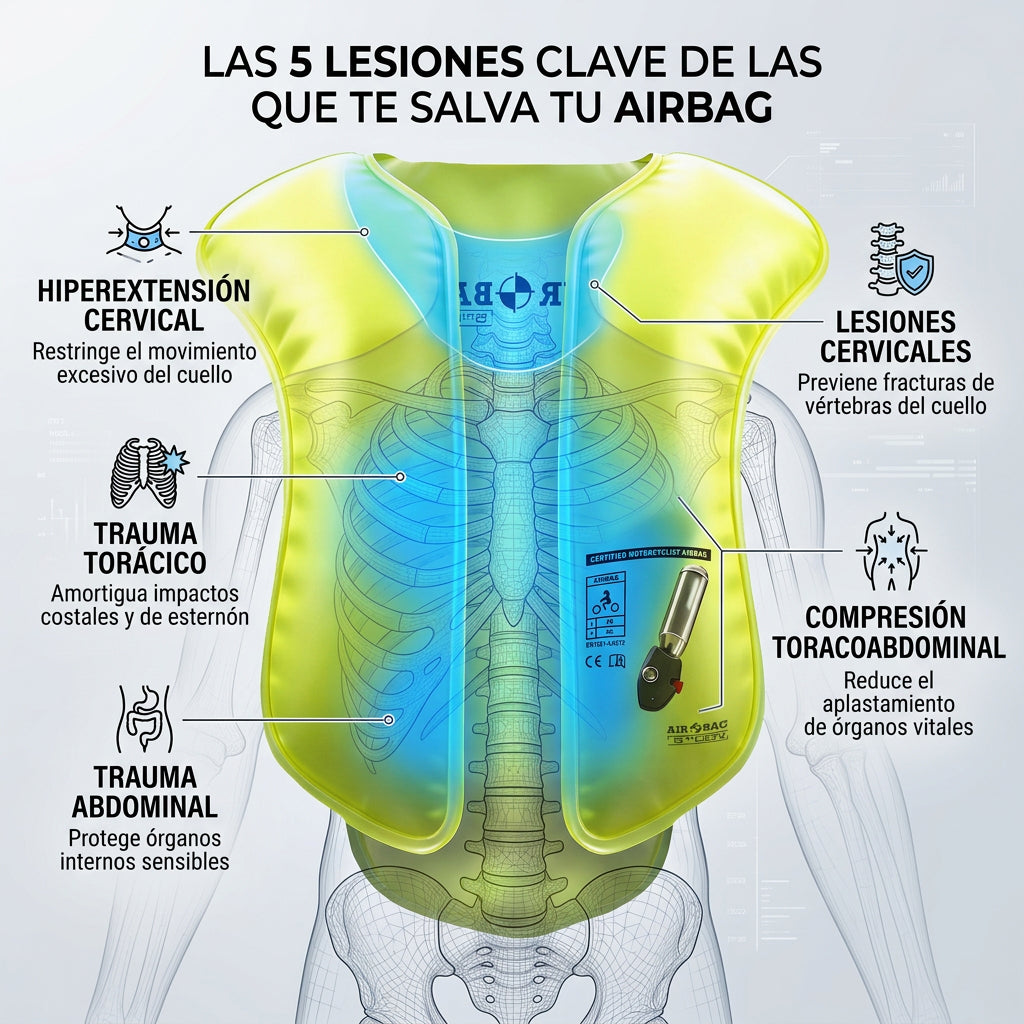
Motorcycle accidents are not a random or unpredictable phenomenon from a scientific point of view. For decades, studies such as MAIDS (Motorcycle Accidents In-Depth Study) have made it possible to understand precisely which regions of the body concentrate severe trauma and, more importantly, which injuries determine survival.
One of the most consistent findings in the literature is that, although the extremities show the highest frequency of injuries, mortality is mainly concentrated in the head, neck, and torso. This implies that any effective protection strategy must focus on these regions, where vital organs and critical structures for life are located.
In this context, the airbag vest for motorcyclists emerges as one of the most relevant technologies in passive safety. Its ability to deploy in milliseconds and modify the dynamics of the impact significantly reduces the energy transmitted to the body. But to understand its true value, it is necessary to analyze exactly what type of injuries it can prevent or mitigate.
The biomechanical logic of motorcycle trauma
When an accident occurs, the motorcyclist's body experiences abrupt deceleration in an extremely short interval. This transition generates high forces that are transmitted directly to tissues and organs.
The fundamental relationship describing this phenomenon is:
F=m⋅a
The only way to reduce force is to increase deceleration time or distribute the load over a larger surface area. Airbags fulfill both functions: they prolong impact time and redistribute energy, reducing the force peaks that cause structural damage to the body.
From this perspective, the most severe injuries are not simply a consequence of the impact, but of how that energy is concentrated in vulnerable structures.
The actual pattern of severe injuries according to MAIDS
Analysis of thousands of real accidents shows a clear pattern. Approximately one-third of deaths are associated with head trauma, while nearly two-thirds originate from neck and torso injuries, particularly in the chest and abdomen.
This is not accidental. The torso houses vital organs such as the heart, lungs, liver, and major blood vessels. Unlike the extremities, these structures do not tolerate significant deformation without compromising life.
The airbag vest acts precisely on these regions, which explains its potential impact on reducing mortality.
Severe chest trauma: the main cause of preventable death
Among all injuries, chest trauma occupies a central place. It includes multiple rib fractures, pulmonary contusion, and, in more severe cases, cardiac injuries or rupture of major vessels.
From a biomechanical point of view, the chest is especially vulnerable because it functions as a semi-rigid structure that transmits impact energy directly to internal organs. When the force exceeds certain thresholds, thoracic deformation causes lung damage and compromises oxygenation.
The airbag reduces this risk by creating a deformable interface between the body and the impact object. By increasing deceleration time, it decreases the maximum transmitted force. In normative terms, a certified system can reduce the force to levels close to 2.5 kN, well below the values associated with critical chest injuries.
Cervical injuries: the structural weak point
The neck is one of the most critical regions in a motorcycle accident. Its function is to support and stabilize the head, but its structure is relatively fragile against dynamic loads.
Cervical injuries include hyperextension, hyperflexion, and vertebral fractures, many of which can result in irreversible spinal cord damage or immediate death.
The biomechanical problem lies in the lever effect: the head acts as a mass that amplifies forces on the neck during impact. Without a system that limits this movement, stresses can quickly exceed physiological limits.
The airbag vest addresses this problem by creating support around the neck that limits the range of motion and reduces the angular acceleration of the head. This significantly decreases the likelihood of severe cervical injuries.
Abdominal trauma: the silent enemy
Unlike the chest, the abdomen lacks a protective bony structure. Organs such as the liver, spleen, and kidneys are exposed and can be injured even with moderate impacts.
Abdominal trauma is particularly dangerous because it may not be immediately evident. Internal bleeding can quickly progress to a critical state without clear external signs.
The airbag provides an absorption surface that distributes impact energy over a larger area, reducing localized pressure on these organs. This effect is key to preventing visceral ruptures and massive bleeding.
Cervical hyperextension associated with secondary impact
A frequent characteristic in motorcycle accidents is the presence of multiple impacts. After the first contact, the body can bounce or slide, generating additional movements that aggravate the initial injuries.
One of the most dangerous mechanisms is cervical hyperextension during these secondary impacts. Even if the first impact is not lethal, the combination of forces can cause fatal spinal cord injuries.
The airbag maintains an inflated structure during these events, providing continuous protection and reducing the range of neck movement in later phases of the accident.
Thoracoabdominal compression and multi-organ failure
In high-energy impacts, the body can experience simultaneous compression of the chest and abdomen. This type of injury combines lung damage, internal bleeding, and circulatory compromise.
From a physiological point of view, this scenario is especially critical because it affects multiple systems at the same time: respiratory, cardiovascular, and metabolic.
The airbag acts as a damping system that reduces the magnitude of compression, preventing impact energy from concentrating at a specific point. This does not completely eliminate the risk, but it can make the difference between a serious injury and a fatal one.
The importance of activation time
All this protection capability depends on a critical factor: time. The airbag must be fully deployed before the main impact.
In certified mechanical systems, activation occurs in the order of tens of milliseconds, and full inflation is achieved in less than 120 ms. This interval is sufficient to intervene in the most critical phase of the accident, where force peaks are generated.
If the system fails to activate or does so late, its effectiveness is drastically reduced. Therefore, the reliability of the activation mechanism is as important as its energy absorption capacity.
Beyond protection: a paradigm shift
The airbag vest is not simply an additional accessory, but a change in the understanding of motorcycle safety. While traditional systems focus on resisting impact, airbags are designed to modify its dynamics.
This represents a more advanced approach from an engineering perspective, as it acts on the direct cause of injuries: force.
Conclusion
Evidence-based analysis shows that the most severe motorcycle injuries are not random. They are concentrated in the neck and torso, where vital organs and the most vulnerable structures are located.
The airbag vest acts precisely on these regions, reducing impact force and limiting dangerous body movements. Its ability to activate in milliseconds and provide distributed protection makes it a key tool for reducing mortality.
It does not eliminate risk, but it intervenes at the critical moment where the outcome of the accident is defined. In that interval of milliseconds, where physics decides the fate of the body, the presence or absence of an adequate protection system can make the difference between life and death.
Share:
How exactly does a motorcycle airbag work, and in how many milliseconds does it deploy?
Is a motorcycle airbag mandatory? Regulations and future (2026)