
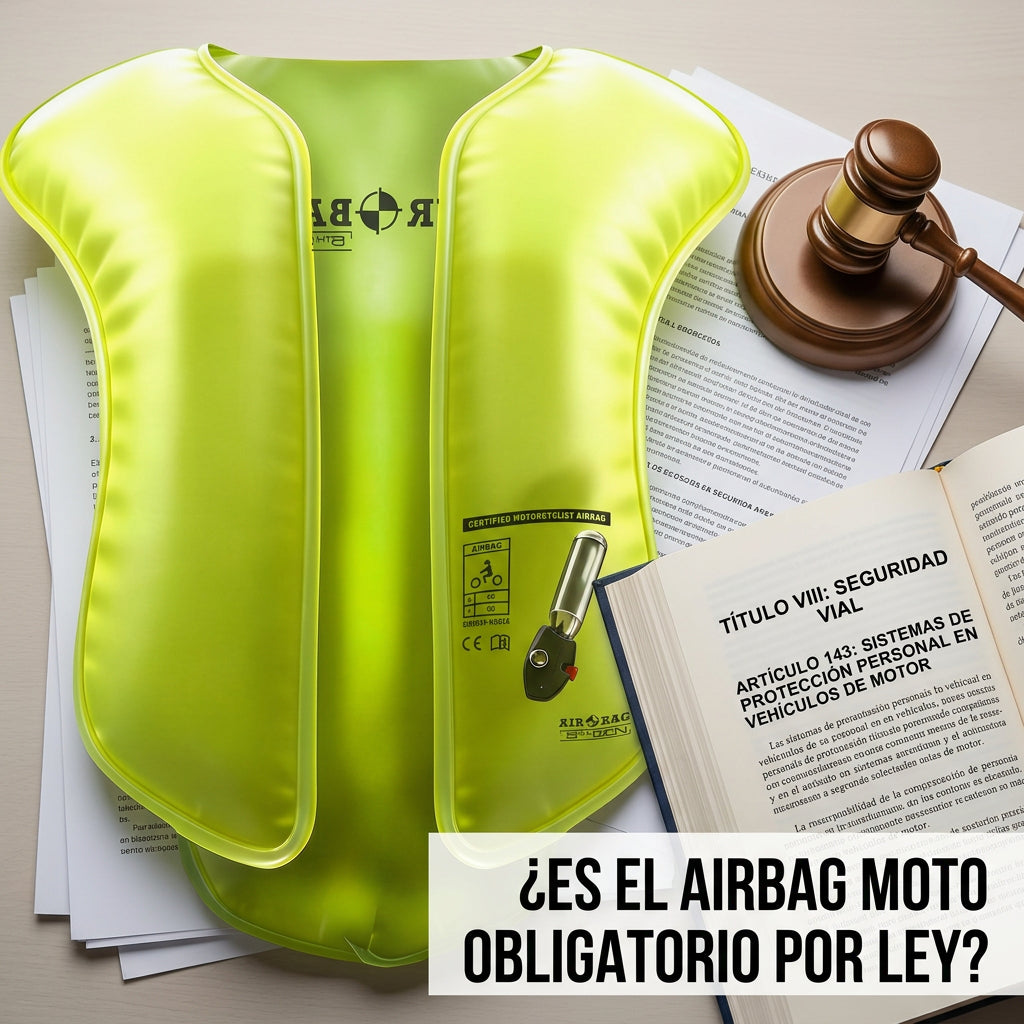
The appearance of airbags for motorcyclists has raised one of the most relevant questions in road safety in recent years: should it be mandatory by law?.
The short answer is clear, but incomplete from a technical perspective:
In 2026, motorcycle airbags are still not mandatory for motorcyclists in any country in the world.
However, the complete answer requires analyzing three dimensions:
- Current regulations
- Regulatory trends
- The scientific logic that could lead to its mandatory use
Only by understanding these three layers is it possible to anticipate what will happen in the future.
The current situation: what the law actually requires
In most countries, including Europe and Latin America, legislation distinguishes between mandatory equipment and recommended equipment.
Today, the only universally mandatory item is an approved helmet. Other items such as motorcycle airbags, gloves, boots, or jackets are usually recommended for use, but are not yet mandatory.
In fact, even in countries with advanced regulations:
- Airbags are not mandatory for circulating on public roads
- Their use is actively promoted by traffic authorities and authorities responsible for the safety and health of motorcycle workers
- They are considered an emerging, high-impact technology
This creates an interesting paradox:
It is one of the most effective technologies, yet it is not yet legally required.
Why is it not mandatory yet?
From a scientific point of view, the answer is not trivial. It is not enough for a technology to be effective; to be mandatory, there must be a change in the culture and belief system of society.
Unfortunately, road safety regulatory bodies are characterized by being very slow in adopting technology, which is why technologies such as seat belts took almost 50 years from their creation until they were mandated to be included as a mandatory passive safety device in cars. The same happened with anti-lock braking system technology known as ABS, which took more than 60 years to be considered mandatory equipment in cars, and almost 80 years to be used in motorcycles.
The answer is simple: road safety has historically been characterized by technological obsolescence; mobility regulators are late adopters of safety technologies.
1. Lack of complete standardization
Although there is a relevant technical standard, EN-1621-4, only three brands in the global market (AIROBAG, HIT-AIR and MOTOAIRBAG) comply with this standard. There is not yet a standard to certify electronic airbags due to their low reliability.
This creates a key problem: the regulatory bodies for the sale of protective equipment do not regulate the quality of personal protective equipment for motorcyclists sold in Europe and Latin America, and that is why more and more brands of Chinese airbags appear on ALIBABA, but they do not comply with the EN-1621-4 certification.
2. Technological variability
There are two main types of airbags:
- Mechanical (cable activated)
- Electronic (sensors and algorithms)
The behavior of both is different, especially in reliability.
From a regulatory perspective, mandating a technology with variable results implies legal and technical risks.
3. Economic barriers
Cost remains a relevant factor. Unlike helmets, which are relatively accessible, airbags represent a greater investment.
Safety regulations usually follow a progressive logic:
- Available technology
- Cost reduction
- Mass adoption
- Mandatory
Cases where it is mandatory
Although it is not mandatory for circulation, there are already scenarios where airbags are required:
Advanced training
In some European countries, such as Spain, it is already mandatory in courses to obtain a high-displacement driving license .
Occupational use of motorcycles
ILO Convention 155 states in Article 16 that:
"Employers shall provide appropriate clothing and protective equipment to prevent the risks of accidents or harmful effects on health."
Given that most countries in the world are signatories to this convention, and that motorcycle airbags are the only personal protective equipment recognized by international regulations to protect vital organs of the torso, their use is mandatory for people who work on a motorcycle or who travel by motorcycle at the employer's direction.
This is extremely relevant because it indicates that labor authorities already recognize its value in controlled environments.
Competition
In disciplines such as MotoGP or the Dakar Rally, the use of airbags is already mandatory.
Emerging regulatory proposals
There are initiatives in some countries to make it mandatory for:
- Professional motorcyclists
- Motorcycle delivery drivers
- Motorcycle workers
This aligns with occupational safety and health regulations.
What do the authorities say about the future?
There is a lot of misinformation about a supposed mandatory nature in 2026. It is important to be precise:
- There is no approved law that mandates the use of airbags in 2026.
However, authorities are:
- Actively promoting its use
- Evaluating its impact on mortality reduction
- Considering its future inclusion
Even traffic agencies have raised the possibility of making it mandatory in the long term
The scientific logic behind a possible mandatory requirement
To understand where regulation is headed, it is necessary to analyze the actual cause of death in motorcyclists. The problem is not speed itself, but the energy of the impact.
This relationship is described by:
F=m⋅a
Mortality occurs when the force exceeds the tolerance of vital organs. Here is where the airbag introduces a fundamental change:
- Increases deceleration time
- Reduces maximum force
- Distributes energy
From a biomechanical point of view, this makes it one of the few technologies that directly address the cause of trauma.
Historical comparison: how standards evolve
To anticipate the future, it is useful to observe how other technologies became mandatory.
Helmet case
- Initially optional
- Then recommended
- Finally mandatory
Today it is unquestionable.
ABS case in motorcycles
- First mandatory in cars
- Then mandatory in high-end motorcycles
- Finally mandatory for all motorcycles in Europe
Common pattern
All technologies follow the same cycle:
- Innovation
- Scientific validation
- Institutional promotion
- Progressive regulation
- Legal obligation
The airbag has already completed the first three phases and is now entering the fourth phase of progressive regulation.
Will it be mandatory in the future?
The most accurate answer is: Probably yes.
The conditions that must be met are:
- Complete standardization (clear rules)
- Cost reduction
- High market penetration
When these factors converge, regulation often changes quickly.
The most probable scenario (2026–2035)
From a technical and regulatory analysis, the most probable future is:
Short term (2026–2030)
- Not mandatory
- Strong institutional promotion
- Increasing use by professional motorcyclists and motorcycle experts
Medium term (2030–2035)
- Mandatory in specific contexts:
- Motorcycle workers
- Motorcycle training
Long term (>2035)
- Possible general mandatory use
- Integration with global road safety regulations
Beyond the law: the technical decision
The key question is not just whether it is mandatory, but whether it should be. From a scientific point of view:
- Protects the most vulnerable regions of the body
- Significantly reduces impact force
- Acts in the critical phase of the accident
The absence of mandatory use does not imply a lack of effectiveness, but rather slowness in the technological adoption process by road safety regulatory bodies.
Conclusion
In 2026, the motorcycle airbag is not yet mandatory for motorcycle use in any country. However, there are already regulations in some countries that require its use for the process of obtaining a motorcycle license, and as mandatory personal protective equipment for motorcycle workers.
Its increasing adoption, institutional support, and biomechanical evidence point to a future where its use will be increasingly widespread and even regulated.
The history of road safety shows that technologies that truly save lives always end up becoming mandatory. The airbag meets all the technical conditions to follow that path.
Share:
The 5 most serious motorcycle injuries that an airbag vest can prevent
Airbag for scooters and cities: Is it overkill or a real necessity?