
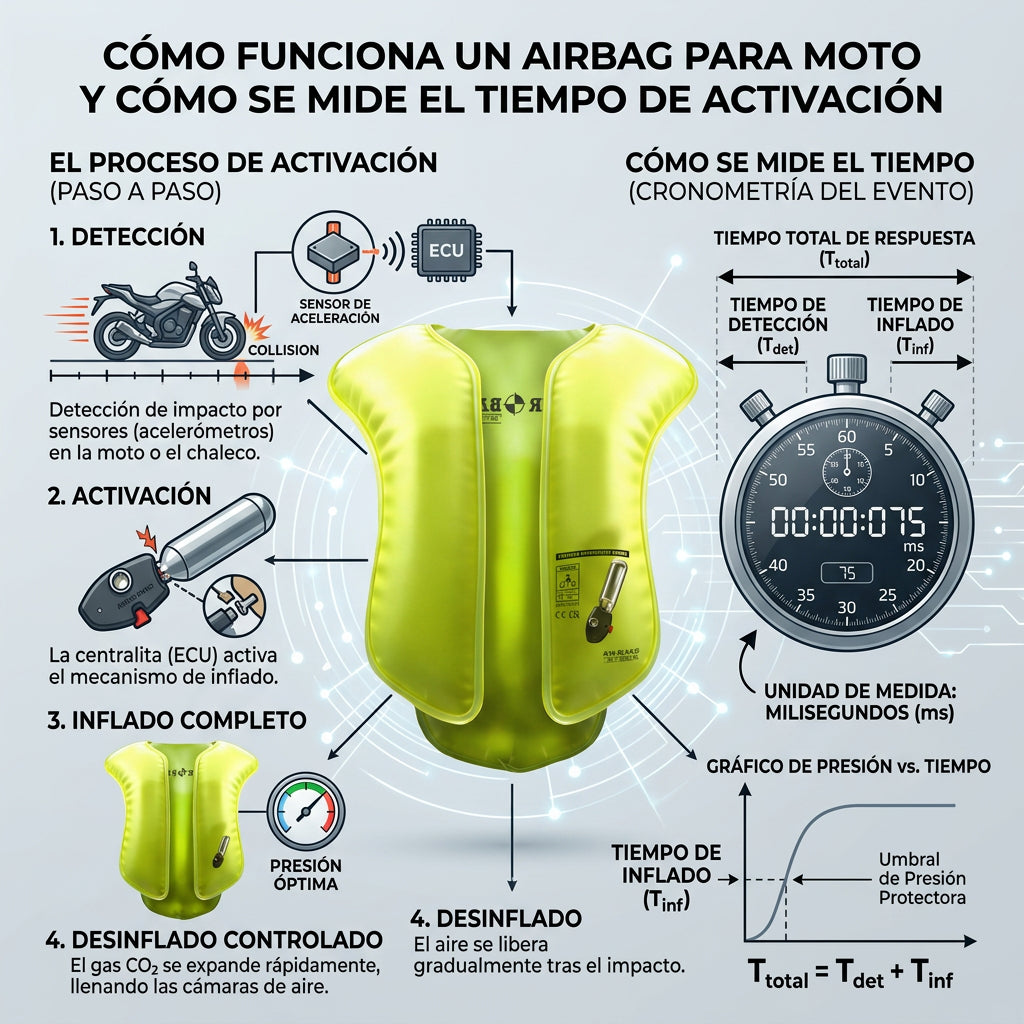
Motorcyclist safety has undergone a significant evolution in recent decades. For a long time, the helmet was considered the only essential protective element. However, the development of airbags for motorcyclists has introduced technology capable of protecting critical body regions such as the neck, chest, and abdomen, where vital organs are concentrated. To understand their relevance, it is necessary to analyze not only what they protect, but how exactly they work and on what time scale they do so, since, in a motorcycle accident, biomechanical events occur in milliseconds.
1. The physical problem: time is the enemy
In a motorcycle accident, the rider's body goes from a certain speed to zero in an extremely short interval. From a physics perspective, this implies abrupt deceleration, and therefore, high forces according to Newton's second law:
F=m⋅a
Where:
The only real mechanism to reduce force is to increase the time over which deceleration occurs. This is where the airbag becomes a superior biomechanical solution: it introduces a deformable volume that extends the impact time and distributes energy over a larger surface area.
2. What exactly is a motorcycle airbag?
A motorcycle airbag is a pneumatic protection system integrated into a garment (vest or jacket) that automatically inflates during an accident.
Its objective is not to prevent the accident, but to modify the impact dynamics, reducing the force transmitted to vital organs.
The areas it protects are:
These regions concentrate approximately two-thirds of the severe trauma associated with mortality in motorcyclists, which explains the relevance of this technology.
3. Components of a mechanical airbag
Mechanical activation systems, which are the only ones certified under the EN-1621-4 standard, consist of:
Connects the rider to the motorcycle.
Activates when the cable is pulled taut due to rider-motorcycle separation.
Releases compressed gas when the percussion mechanism is activated.
Fills rapidly, forming a protective cushion.
Controls how the air expands to protect specific areas.
4. Exact activation sequence (step by step)
Operation occurs in an extremely rapid chain of events:
Phase 1: Accident onset (0 ms)
The motorcyclist begins to separate from the motorcycle.
Phase 2: Mechanical activation (~10–20 ms)
The cable tightens and activates the percussion mechanism that punctures the CO₂ cartridge.
Phase 3: Gas release (~20–40 ms)
Gas begins to fill the airbag chamber.
Phase 4: Full inflation (~80–120 ms)
The airbag reaches its optimal pressure and volume.
Phase 5: Impact (~200 ms)
The body makes contact with the ground or an object.
5. How many milliseconds does it actually take to activate?
A certified mechanical system typically:
This is critical because the main impact in many accidents occurs within the first 150 ms. The certified airbag is fully inflated before or right at the moment of impact, which significantly reduces the transmitted force.
6. Comparison with electronic airbags
Electronic systems use:
-Advantages:
-Critical limitations:
They must distinguish between normal riding and an accident.
Currently, there is no equivalent standard to EN-1621-4 for these systems, due to reliability issues.
-Activation time:
Although they can be fast, the problem is not just time, but the certainty of activation.
From a safety engineering perspective, a system that does not guarantee activation in all critical scenarios cannot be considered fully reliable.
7. Why is activation time so important?
Impact is not an instantaneous event, but a deceleration curve. The key is to intervene before the peak force.
Without protection:
With airbag:
In regulatory terms, a certified airbag reduces impact force much more than a certified helmet:
This implies that the airbag can reduce the impact force on the torso up to 5 times compared to traditional systems.
8. Critical factor: inflation speed vs. accident speed
A common mistake is to think that “faster is always better.” In reality, the critical thing is that the system:
Mechanical airbags have a fundamental advantage:
They are activated by a direct physical condition (separation)
This eliminates algorithmic uncertainty.
9. Reliability: the true differentiator
In functional safety, the key parameter is not just speed, but the probability of correct operation when needed.
This explains why, at a regulatory level, only mechanical systems currently have a complete regulatory framework.
10. Conclusion: milliseconds that define life
A motorcycle airbag is not simply an accessory, but an engineered system designed to intervene within an extremely narrow time window.
The difference between serious injury and survival depends on:
From a scientific and biomechanical point of view, certified mechanical airbags currently represent the most robust solution available for the protection of vital organs in motorcyclists.
Share:
Comparative Analysis of Airbags for Motorcyclists
The 5 most serious motorcycle injuries that an airbag vest can prevent