
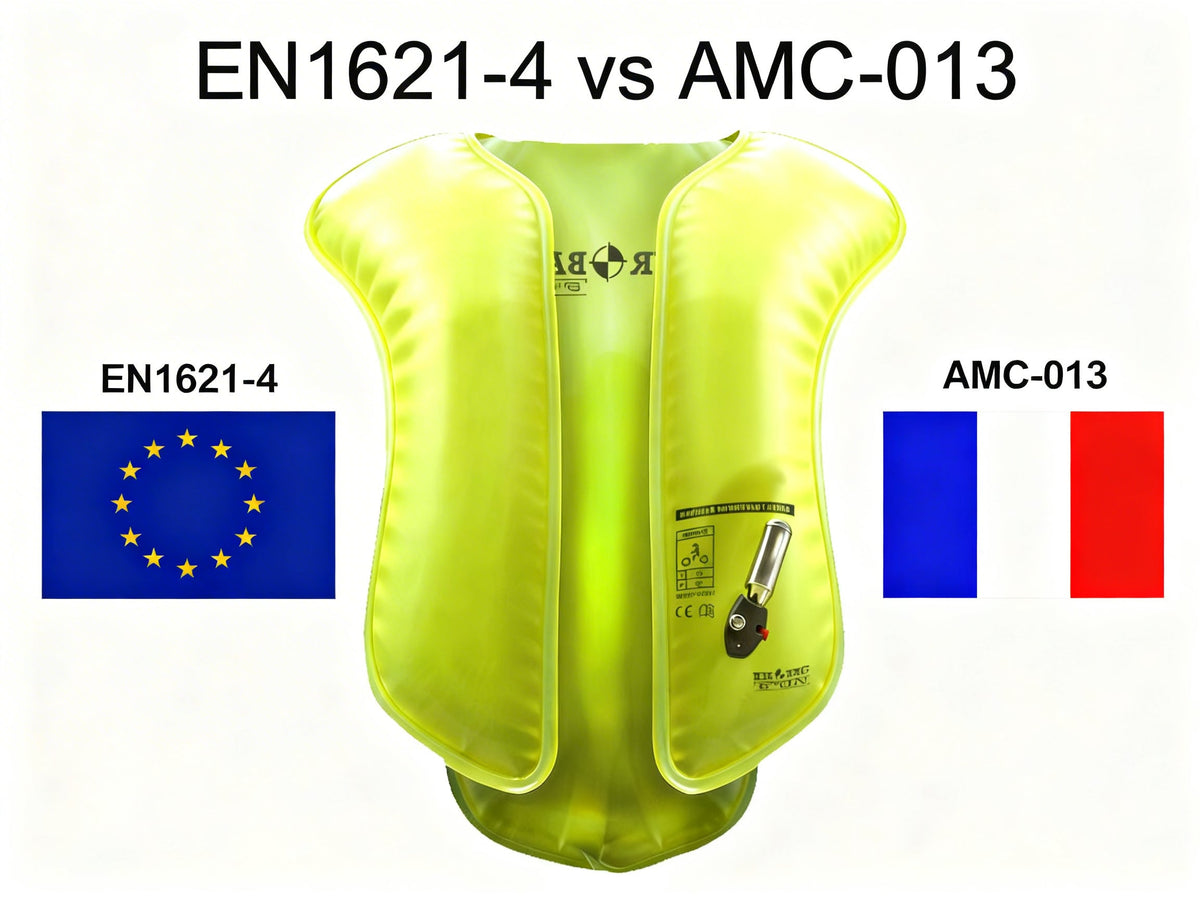
Airbags are one of the most important advances in motorcyclist safety this century, but not all are certified to the same level of stringency, and the buyer can almost never know. How do you choose?
In the European Union, there are currently three ways to certify a motorcycle airbag, and all three allow it to be sold legally with the CE marking:
- The European standard EN 1621-4, approved by the European Committee for Standardization (CEN) on November 3, 2012, and published in 2013. It only applies to mechanically activated airbags.
- The CRITT AMC-013 protocol (and its version AMC-012), a private specification from the French laboratory CRITT Sport Loisirs. Its first version dates back to September 27, 2005: it predates the European standard by seven years and has been revised several times since then.
- The CERTOTTICA M.115 protocol, a private specification from an Italian laboratory used by two brands from that country that only manufacture electronically activated airbags.
According to the catalog of the Technical Guide for Motorcycle Airbags, prepared by ANESDOR in collaboration with the DGT (Spain's Directorate-General for Traffic), only three brands state that they certify to EN 1621-4: AIROBAG, HIT-AIR, and MOTOAIRBAG. Most are listed under the CRITT AMC-012/013 protocol.
Why would a mechanical airbag be certified to a private protocol rather than to the European standard?
Are the two tests comparable?
What exactly does an AMC-013 certificate demonstrate?
To answer these three questions, we compare the impact attenuation thresholds required by the EN 1621-4 standard and the AMC-013 protocol.
Since AIROBAG certifies its airbags to EN 1621-4 and is an interested party, every figure includes its source or calculation. These are the results.
1. Starting point: two different ways of measuring the same impact
The two documents express the impact test result in different quantities. The standard measures force; the protocol measures acceleration. Neither is a measure of energy: the energy of the impact is the same in both tests. What changes is how much of that impact is allowed to reach the body.
| EN 1621-4 | AMC-013 | |
|---|---|---|
| What it measures | Transmitted force (kN) | Impactor deceleration (g) |
| Where | Load cell under the anvil | Accelerometer on the impactor |
| Limit per impact | Level 1: 6 kN / Level 2: 3 kN | 500 g |
| Mean value limit | Level 1: 4.5 kN / Level 2: 2.5 kN | None |
| Time criterion in impact test | No | Yes (time above 80 g) |
The key question is whether the two quantities can be converted into each other. The answer is yes, using Newton's second law, within the limits explained below.
2. Test apparatus: what each document specifies
The two tests drop the same mass with the same energy. What changes is the shape of the striking object, the surface the airbag rests on, and the point of measurement.
AMC-013 (§5.4):
- Impactor mass: 5 ± 0.05 kg
- Impactor face: flat disc Ø 130 ± 3 mm, with edge rounded to 2 mm
- Impact energy: 50 ± 1.5 J (5 kg from 1.02 m)
- Impact velocity: v = √(2 × 9.81 × 1.02) = 4.47 m/s
- Anvil: flat polished steel plate, 30 × 30 cm and 1 cm thick, covered with 1.5–2.5 mm leather
- Measurement: single-axis accelerometer on the impactor, filtered to CFC 1000 (ISO 6487)
EN 1621-4:
- Refers to the test apparatus of EN 1621-2 (back protectors) and, for the chest, of EN 1621-3.
- 5 kg mass and 50 J energy, the same as AMC-013.
- Impactor in the form of a 160 × 50 mm bar with the impact face rounded to a 12.5 mm radius. The EN 1621-2 standard itself explains that the test provides information on protection against impacts with edges, such as curbs.
- Anvil: steel cylinder Ø 100 mm with a domed top face (150 mm radius). The airbag rests on this small, convex surface.
- Force is measured with a load cell under the anvil: this is the force passing through the protector to the body.
- Measurement: piezoelectric load cell, with the same CFC 1000 (ISO 6487) filtering class as AMC-013.
3. Conversion
During contact, the force decelerating the impactor comes directly from Newton's second law. For a free-falling impactor:
F = m · (a + g)
The weight term (m · g) is 49 N, barely 0.2% of the force at 500 g. It is negligible compared to the tolerances of the tests themselves, so in practice F ≈ m · a.
By Newton's third law, this force is equal and opposite to the one the impactor exerts on the airbag. The airbag transmits it to the anvil, minus only the inertia of its own material: the fabric and gas weigh a few tens of grams compared to the 5 kg impactor, so this difference is also negligible.
Conversion of the AMC-013 limit:
F = 5 kg × 500 × 9.80665 m/s² = 24,517 N ≈ 24.5 kN
4. Direct comparison of thresholds
| Criterion | EN 1621-4 Level 2 | EN 1621-4 Level 1 | AMC-013 |
|---|---|---|---|
| Single impact (kN) | 3 kN | 6 kN | 24.5 kN equivalent |
| Single impact (equivalent g) | 61 g | 122 g | 500 g |
| Mean value (kN) | 2.5 kN | 4.5 kN | Not specified |
First-order conclusion: at peak force, the AMC-013 threshold is about 4 times more permissive than EN 1621-4 Level 1 and about 8 times more permissive than Level 2.
To put the figure in perspective: the back protector standard, EN 1621-2, does not allow any impact above 24 kN even at its lowest level, with the same 50 J energy. The threshold that AMC-013 accepts for an inflated airbag is in the range of what Europe tolerates for a conventional Level 1 back protector.
5. The AMC-013 time criterion: does it compensate for the difference?
§4.8 of AMC-013 adds two conditions regarding the acceleration curve:
- Criterion A: no impact may exceed 500 g.
- Criterion B: the average, across all impacts, of the time the acceleration spends above 80 g may not exceed 3 ms, and for any single impact it may not exceed 3.2 ms.
80 g on the 5 kg impactor is equivalent to 3.92 kN (5 × 80 × 9.80665 N). Criterion B therefore limits how long a force greater than about 3.9 kN can be transmitted. It is a "3 ms"-type criterion, taken from automotive impact biomechanics.
Does it compensate for the higher threshold? No. Criterion B limits duration, not the peak. A very sharp impact, reaching 500 g in a very short pulse, stays above 80 g for only a short time and meets the criterion easily. With a half-sine pulse model without rebound, an impact at the 500 g limit would be above 80 g for only about 1.3 ms.
The criterion also works in reverse, and it is worth stating. For the same impact, an airbag that decelerates more gently spreads the force over more time. With the same model, an airbag right at the EN 1621-4 Level 1 limit (6 kN) would spend about 3.2 ms above 80 g, at the edge of Criterion B. A Level 2 airbag (3 kN max) does not reach the 3.92 kN equivalent to 80 g in its test.
6. Differences that prevent exact equivalence
Three factors prevent the conversion from being a perfect equivalence.
a) Impactor geometry. AMC-013 strikes with a flat disc 130 mm in diameter (about 133 cm²). EN 1621-4 strikes with a rounded-edge bar, which concentrates the load in a narrow strip. One could object that the disc distributes the load better and that it is therefore reasonable to allow more force. Geometry does, indeed, make it impossible to compare the figures one-to-one. But that same objection does not hold for the support, as seen in the next point.
b) Anvil. In EN 1621-4, all the force must pass through a domed anvil only 100 mm in diameter. In AMC-013, the airbag rests on a flat 30 × 30 cm plate, on which it can spread and distribute the load with maximum efficiency. This choice favors the AMC test result.
c) Point of measurement. AMC-013 measures on the impactor; EN 1621-4 measures under the anvil. With an airbag of a few tens of grams against a 5 kg impactor, and with the same filtering class (CFC 1000) in both tests, this difference does not appreciably alter the peak value.
7. Summary of the comparison
| Aspect | EN 1621-4 | AMC-013 | Equivalent? |
|---|---|---|---|
| Impact energy | 50 J (via EN 1621-2) | 50 J | ✓ Yes |
| Impactor mass | 5 kg | 5 kg | ✓ Yes |
| Signal filtering | CFC 1000 (ISO 6487) | CFC 1000 (ISO 6487) | ✓ Yes |
| Limit per impact | 3 kN (Level 2) – 6 kN (Level 1) | 24.5 kN equivalent | ✗ No: AMC-013 is 4 to 8 times more permissive at the peak |
| Mean value limit | 2.5 kN – 4.5 kN | None | ✗ No |
| Time criterion in impact test | No | Yes | Partial: adds a condition EN 1621-4 lacks, but does not limit the peak |
| Quantity measured | Force under anvil (kN) | Impactor acceleration (g) | Convertible via Newton’s 2nd Law |
| Impactor | Rounded-face bar (r 12.5 mm) | Flat disc Ø 130 mm | ✗ No: the disc distributes load more |
| Anvil | Domed, Ø 100 mm | Flat 30 × 30 cm plate | ✗ No: the plate favors the result |
8. In a nutshell
Both tests strike the airbag in the same way: a 5 kg weight dropped from one meter. What changes is how much of that impact is allowed to reach your body.
- The European standard EN 1621-4 allows a maximum of between 3 and 6 kilonewtons (kN, the unit of force) to pass, depending on the level.
- The AMC-013 protocol allows the equivalent of 24.5 kN: between four and eight times more.
It is like two exams with the same questions where one is passed with many more mistakes than the other. Therefore, the fact that an airbag passes AMC-013 does not prove it would pass the European standard.
This does not mean that an airbag with an AMC-013 certificate is bad. It can be a good product. It means that its certificate is less demanding and, therefore, proves less.
Before buying, check three things:
- The standard. Look on the label and in the manual for the "EN 1621-4" reference and the level achieved: 1 or 2. Level 2 is the more demanding.
- The zones. Check that the certificate covers the chest and back, not just one of the two.
- The report. If the product indicates "AMC", "CRITT", or another protocol, ask the manufacturer for the test report and ask what force was measured, in kN.
Share:
Helmet vs. Motorcycle Airbag Protection Comparison
The motorcycle accident, a problem that does have a solution