
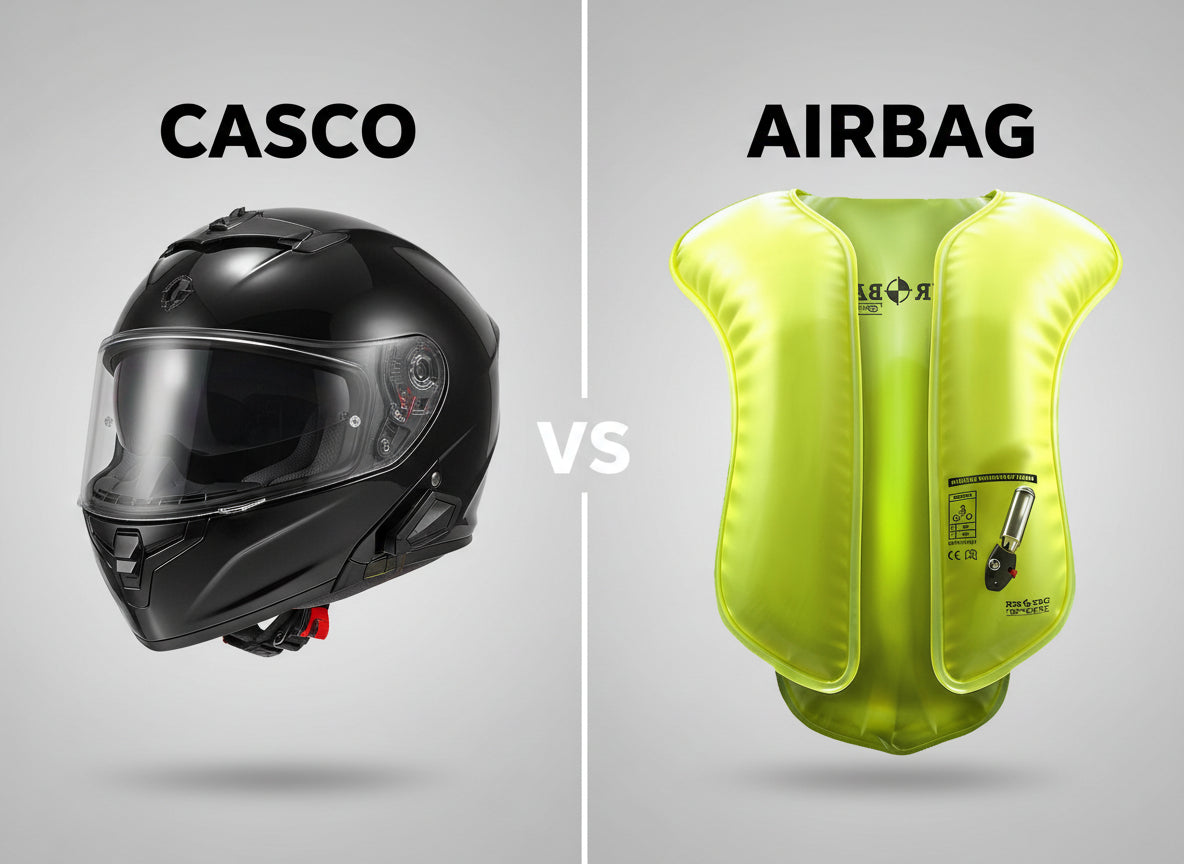
For over 100 years, the helmet has been discussed as the sole safety device for motorcyclists, but the 21st century surprised us with the arrival of a new technology that has been shown to reduce the risk of death in a motorcycle accident by more than 90%—motorcycle airbags. In this document, we compare the efficiency and effectiveness of both technologies: Which protects more? Which absorbs more energy? What should motorcyclists use?
Motorcycle accidents represent one of the leading causes of mortality in transport. Unlike car occupants, motorcyclists lack a passive protective structure to absorb impact energy. For this reason, scientific research has focused on understanding which body regions suffer the most critical injuries and how personal protective equipment can reduce the severity of trauma. Three studies have been particularly influential in understanding the biomechanics of motorcycle trauma: the MAIDS Study (Motorcycle Accidents In-Depth Study), the Hurt Report, and the SAFERIDER project. These works analyze real accidents with technical and medical reconstruction, using injury classification systems such as the AIS (Abbreviated Injury Scale). All studies have reached a common conclusion: although the extremities show the highest frequency of injuries, the regions that concentrate mortality are the head, neck, and torso. Therefore, the analysis of motorcyclist protection must focus primarily on these anatomical regions.
Methodology.
To objectively compare the different accident studies and the certification tests for protective technologies, a comparative synthesis of the results published in the three aforementioned studies was carried out. To estimate the potential coverage of protection systems, the anatomical distribution of severe trauma (AIS ≥3) relevant to mortality, excluding extremities, was considered.
Subsequently, the impact force reduction capacity was estimated using typical helmet certification parameters, specifically the ECE-22.06 standard, recognized as the mandatory technical regulation for helmets in the European community and adopted as a global standard, and the EN-1621-4 technical standard , which is the standard developed by the European Committee for Standardization (CEN) for the homologation of motorcycle airbags, and the only globally recognized and adopted standard for certifying this new technology.
The force calculation is based on Newton's second law: F = m · a where F is force, m is mass, and a is acceleration. In helmet tests, headforms with an approximate mass of 5 kg and maximum accepted acceleration limits close to 275 g (gravities) are used. For certified airbags, impact tests are performed with a 5 kg mass from a height of one meter, and the force transmitted to the torso is measured directly, where the EN-1621-4 standard specifies two levels of protection: level 1, where an average transmitted force of less than 4.5 kN (kilonewtons) is accepted, and level 2, where the average transmitted force must be less than 2.5 kN.
Results.
By consolidating information from accident studies, a statistical distribution of severe trauma relevant to mortality is observed as follows:
· Head: 30–35 % of deaths
· Neck, chest, and abdomen: 65–70 % of deaths
This indicates that the torso accounts for the largest proportion of severe trauma associated with life-threatening risks, mainly because it concentrates the greatest number of vital organs and represents approximately 43% of body mass. However, the head remains the single region with the highest concentration of fatal injuries despite accounting for only 7% of body mass. From this distribution, the potential coverage of protection systems can be estimated.
|
Protection Equipment |
Certification Standard |
Protected Region |
Potential Coverage of Severe Trauma |
|
Helmet
|
ECE-22.06 |
Head |
~30–35 % |
|
Motorcycle Airbag
|
EN-1621-4 |
Neck, Chest and Abdomen |
~65–70 % |
In conclusion, it is evident that the helmet primarily protects the head, where craniocerebral trauma is the cause of one-third of motorcycle deaths, while motorcycle airbags protect the neck, chest, and abdomen, where vital organs causing two-thirds of motorcyclist mortality are concentrated. It is important to note that these levels of protection can only be provided by products duly certified under the aforementioned standards, which are recognized by the scientific community and legislation. Users are warned that the market is flooded with counterfeit protective equipment that is not certified under the mentioned standards due to its poor quality. Special care must be taken with the traceability process of product quality and suitability by verifying the safety triangle (standard + certification laboratory + document).
Regarding coverage, the big winner in this comparison is the motorcycle airbag certified under EN-1621-4 for chest and back protection.
Calculation of impact forces.
To compare the impact energy absorption capacities of both protective equipment, the minimum energy absorption values established by both standards, ECE-22.06 for helmets and EN-1621-4 for airbag systems, were taken. Since the helmet standard (ECE-22.06) establishes its acceptance thresholds by measuring accelerations using gravities as the unit of measurement, and the airbag standard (EN-1621-4) establishes its acceptance criteria by measuring residual force using Kilonewtons as the unit of measurement, we performed a conversion process to compare both standards using the same unit of measurement, in this case, force measured in Kilonewtons.
In the ECE-22.06 helmet certification tests, the acceleration transmitted to the head is limited to approximately 275 g (gravities). Using a head model with a mass of 5 kg and converting the units of measurement from gravities to kilonewtons (kN), we obtain:
a= 275 × 9.81 m/s² ≈ 2697 m/s²
F = m · a = 5 kg × 2697 m/s² ≈ 13,485 N
This is approximately equivalent to 13 kN of residual force accepted in the ECE-22.06 helmet impact test. In contrast, motorcycle airbags certified under EN-1621-4 reduce the force transmitted to the torso to approximately 2.5 kN at Level 2 and 4.5 kN at Level 1, depending on the certification level. Some of the airbags available on the market show impact test results close to 1 kN.
|
Protective Equipment |
Certification Standard |
Permitted Residual Force |
|
Helmet
|
ECE-22.06 |
13 kN |
|
Motorcycle Airbag
|
EN-1621-4 |
2.5 kN Level 2 4.5 kN Level 1 |
The difference is explained by the principle of conservation of linear momentum. Airbags increase the deceleration time of the impact and distribute the energy over a larger surface, significantly reducing the maximum force experienced by the body.
Regarding the level of energy absorption, again, the clear winner of this comparison is the motorcycle airbag certified under EN-1621-4, as a Level 2 certified airbag system is capable of absorbing 5 times more impact force than a helmet approved with the ECE-22.06 standard.
Conclusions:
The accident studies analyzed show a consistent pattern in the distribution of fatal injuries in motorcyclists. Approximately one-third of severe trauma occurs in the head and nearly two-thirds in the neck and torso.
The results show that the helmet protects the region with the greatest neurological vulnerability, while the airbag protects the largest proportion of the body associated with severe vital organ trauma causing death, with the airbag being the equipment with the greatest protective coverage.
From a biomechanical point of view, airbags have a far superior advantage in reducing the maximum transmitted force thanks to their greater deformation travel. This leads us to consider whether it is time to redesign the energy absorption technologies of helmets, as they seem to have become technologically obsolete compared to the new impact absorption technologies presented by motorcycle airbags.
Both systems have different coverage and energy absorption levels, but they also serve different functions and are therefore complementary rather than competing. The helmet reduces the risk of head injury, while the airbag reduces cervical hyperextension injuries, and severe thoracic and abdominal injuries.
From the above, we can conclude that the most complete protection for motorcyclists is obtained by using motorcycle airbags certified under EN-1621-4 Level 2 in conjunction with helmets approved under ECE-22.06.
Share:
The ABCs of Motorcycle Protective Gear
EN 1621-4 vs. AMC-013 // Technical comparison of airbag test methods