
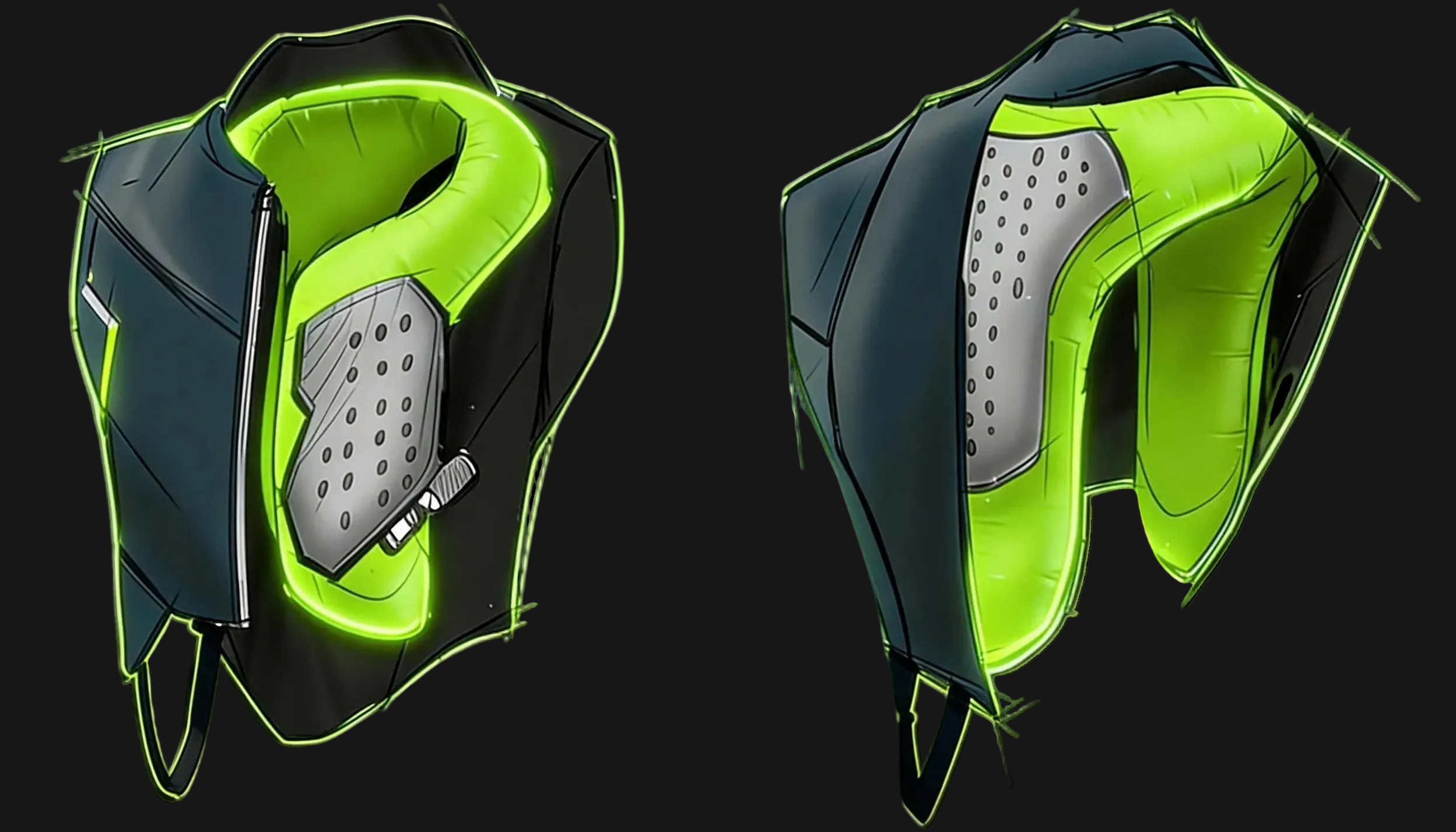
The motorcycle airbag is a young technology, yet it is already part of the most demanding protective gear a rider can wear. Here is where it comes from, how it works and which certifications exist today.
1. From the car to the motorcycle
Airbags first became established in cars. According to the US National Highway Traffic Safety Administration (NHTSA), frontal airbags saved 50,457 lives in the United States between 1987 and 2017.
Bringing the idea to motorcycles meant solving a different problem: the rider is not held in a seat but is thrown off the bike. That is why a motorcycle airbag is not fitted to the vehicle but to a garment worn by the rider. In the late 1990s, in Japan, the company Mugen Denko began selling one of the first mechanically activated airbag jackets, sold under the Hit-Air brand since 2001.
In racing, the Fédération Internationale de Motocyclisme (FIM) made airbags built into the racing suit mandatory for all MotoGP, Moto2 and Moto3 riders from the 2018 season.
2. What it is and how it works
A motorcycle airbag is a pneumatic system built into a vest, jacket or suit. In a crash it inflates with gas and protects the vital organs of the neck, chest and abdomen. There are two ways to trigger it:
- Mechanical activation: the airbag inflates when the rider separates from the bike and pulls the tether cable, with no batteries or electronics. After a crash it can be reused by replacing the gas cartridge.
- Electronic activation: sensors and algorithms detect the crash and trigger inflation. This is the technology used in racing suits.
3. How a motorcycle airbag is certified
Motorcycle airbags are Personal Protective Equipment (PPE). To be sold in the European Union with CE marking, they must pass an examination by a notified body. Today there are three ways to demonstrate their protection:
- The European standard EN 1621-4, approved by the European Committee for Standardization (CEN) in 2012 and published in 2013. It is the only CEN standard for motorcycle airbags and applies to mechanically activated ones. It measures the force the airbag lets through to the body and classifies the result into two levels: level 1 allows at most 6 kN per impact, and level 2, the most demanding, 3 kN.
- The CRITT AMC-013 protocol (and its AMC-012 version), a private specification from the French laboratory CRITT Sport Loisirs, which is a notified body. Its limit is 500 g of impactor deceleration, equivalent to about 24.5 kN: between 4 and 8 times more permissive than the European standard.
- The CERTOTTICA M.115 protocol, a private specification from an Italian laboratory for electronically activated airbags.
Electronic airbags do not yet have a CEN standard: the one that would apply to them, EN 1621-5, has not been published. That is why they are certified under private protocols. An electronic airbag not declaring EN 1621-4 is not the manufacturer's choice: there is currently no CEN standard to assess it against.
We explain the difference between the standard and the AMC-013 protocol in detail in EN 1621-4 vs. AMC-013: technical comparison of airbag test methods.
4. What the ANESDOR catalogue shows
The Spanish two-wheeler industry association (ANESDOR), in collaboration with Spain's Directorate-General for Traffic (DGT), publishes a catalogue of airbags for motorcyclists. The data are declared by each manufacturer or distributor, and the platform itself states that ANESDOR and the DGT are not responsible for their accuracy. As consulted on 5 October 2026, the catalogue lists 20 brands and 68 models:
- 3 brands declare the European standard EN 1621-4: AIROBAG, HIT-AIR and MOTOAIRBAG.
- 15 brands and 39 models declare the CRITT AMC-012/013 protocol. They include 10 mechanically activated models that could be assessed under the European standard.
- 2 brands and 13 models, all electronic, declare CERTOTTICA M.115.
We analyse the catalogue brand by brand in Comparative Analysis of Airbags for Motorcyclists.
5. Before you buy: standard + laboratory + document
All three routes allow legal sale, but they do not require the same. This does not mean that an airbag with an AMC certificate is bad: it may be a good product. It means that its certificate requires less and therefore proves less. Before buying, check three things:
- Standard: look on the label and in the manual for the reference "EN 1621-4" and the level achieved (1 or 2; level 2 is the most demanding). Check that the certificate covers both chest and back.
- Laboratory: confirm that the certificate was issued by a notified body listed in the European Commission's NANDO database.
- Document: ask for the certificate and verify its authenticity with the issuing body. If the product states "AMC", "CRITT" or another protocol, ask the manufacturer for the test report and what force was measured, in kN.
An airbag certified to EN 1621-4 and a helmet approved to ECE 22.06 are today the most demanding certified protection available to a motorcyclist.
Sources: NHTSA, estimate of lives saved by frontal airbags 1987–2017 · Hit-Air brand history (Mugen Denko, Japan) · FIM MotoGP World Championship regulations, 2018 season · Regulation (EU) 2016/425 · EN 1621-4 standard (CEN, 2013) · CRITT AMC-013 protocol · CERTOTTICA M.115 protocol · ANESDOR catalogue of airbags for motorcyclists (airbag.anesdor.com, consulted on 5 October 2026).
Share:
The motorcycle accident, a problem that does have a solution
Comparative Analysis of Airbags for Motorcyclists