
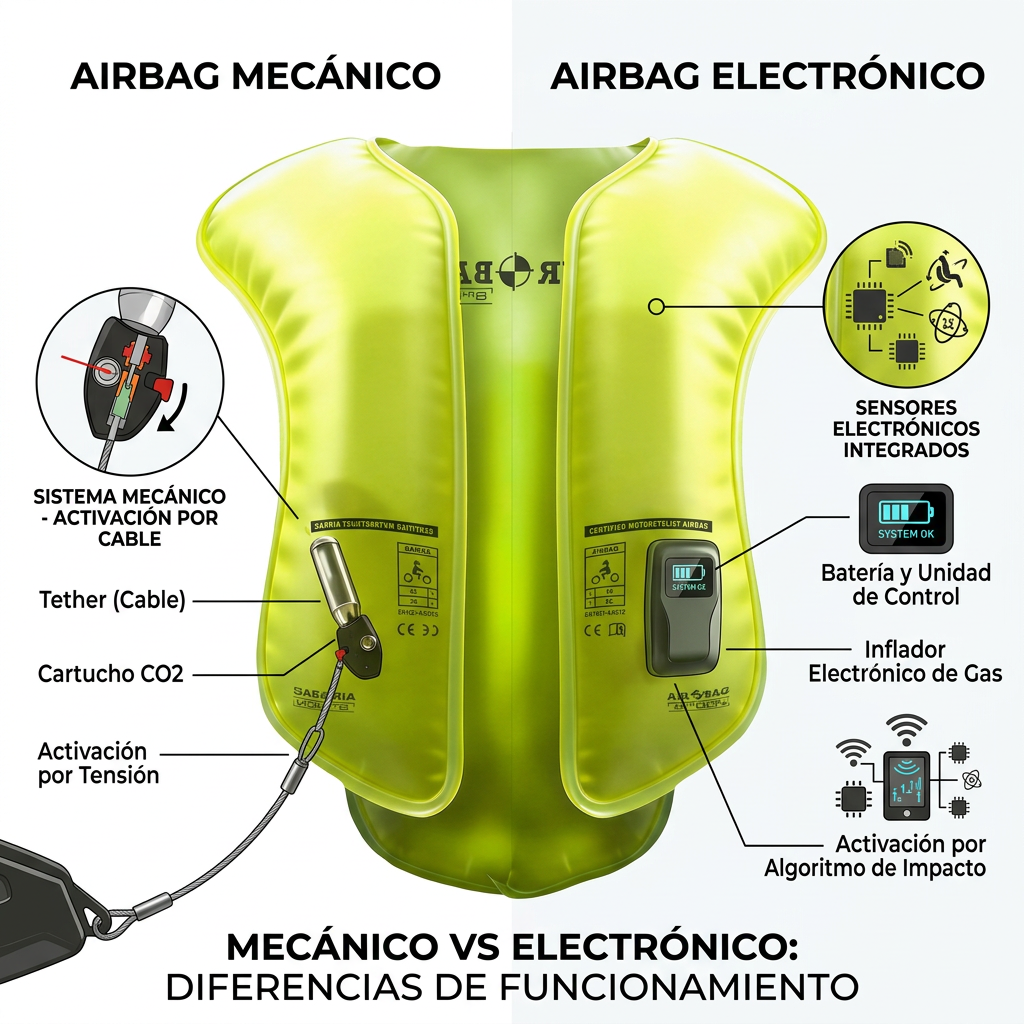
The arrival of the airbag in the world of motorcycling has been a turning point for rider safety. However, as this technology has become more widespread, a clear divide has emerged between two design approaches: mechanically activated systems and electronically activated systems. At first glance, both seem to serve the same purpose, "inflating during a crash to protect the rider," but when analyzed from the standpoint of engineering, biomechanics, and reliability, the differences are profound.
Understanding these differences is not a theoretical exercise. It is a practical matter that directly affects the likelihood that the system will work properly at the only moment that truly matters: the crash.
Two Completely Different Design Philosophies
The starting point for comparing the two systems is understanding that these are not just two different technologies, but two opposing activation philosophies.
A mechanical airbag works on a direct physical principle: the separation between the rider and the motorcycle. A tether connects the rider to the vehicle, and when that connection is abruptly broken, a striker is triggered that releases the gas from the cartridge, inflating the airbag in milliseconds. There is no interpretation, no sensors, no software. It is an immediate physical reaction to a physical event.
An electronic airbag, by contrast, relies on a set of sensors (accelerometers, gyroscopes) and an algorithm that analyzes the rider's behavior in real time to decide whether a crash is occurring. It is, in essence, a probabilistic detection system that tries to distinguish between normal riding and a hazardous situation.
This initial difference shapes everything else.
The Time Factor and Crash Detection
In a motorcycle crash, the time available to react is extremely limited. Critical events unfold within a window of milliseconds, and any delay in activation reduces the system's effectiveness.
The force the body experiences depends on deceleration. To reduce it, the airbag must be fully deployed before the main impact.
Mechanical systems have a structural advantage here: they don't need to "detect" the crash. Activation occurs the instant the rider separates from the motorcycle, which is an unambiguous physical condition in most crash scenarios. This eliminates decision time.
Electronic systems, on the other hand, must first identify that a crash is occurring. This process involves collecting data, processing it, and making a decision. Although processing times are fast, they are never zero. And more importantly, the issue is not only speed, but certainty.
The Reliability Problem in Electronic Systems
From a safety engineering standpoint, reliability is the most important parameter. It is not enough for a system to work well most of the time; it must work correctly every time.
Electronic airbags have two structural problems:
On the one hand, false activations. The system may interpret a sudden maneuver, a pothole, or hard braking as a crash and deploy the airbag unnecessarily. Although this does not directly endanger the rider's life, it does affect usability and user confidence, in addition to generating extra costs.
On the other hand, non-activations. This is the most critical problem. If the algorithm does not recognize a real crash, the airbag does not deploy. In that scenario, the system simply fails to do its job.
These failures are not anecdotal; they are inherent to any system based on data interpretation. No algorithm has been shown to anticipate with absolute certainty "all" the possible combinations of a real crash.
Software Dependency: An Additional Vulnerability
Unlike mechanical systems, electronic airbags depend entirely on software to function. This introduces an additional layer of complexity and vulnerability.
Some systems on the market, such as those built on subscription-based platforms, require the user to keep a recurring payment active for the airbag to work. If the subscription is not active, the system may be disabled, even if the hardware is in perfect condition.
From a safety perspective, this raises a fundamental question: a system designed to save lives should not depend on external conditions such as the status of a subscription.
Introducing this kind of dependency adds a point of failure that does not exist in mechanical systems.
Certification: The Difference Between Validation and Marketing
Another key aspect of the comparison is certification. In the field of personal protective equipment, the existence of a technical standard is what makes it possible to objectively validate a product's performance.
For motorcycle airbags, there is a clear benchmark: the European standard EN 1621-4. This standard evaluates critical aspects such as energy absorption, activation time, coverage, and system reliability.
However, despite having provided guarantees to consumers since 2013 (a pass threshold for impact attenuation, and the fact that it cannot be modified unilaterally, as happens with private protocols), EN 1621-4 is not currently the most widely adopted standard among manufacturers, not even among those that produce mechanically activated motorcycle airbags, which could be tested under it.
Using as a source this catalog compiled by ANESDOR and the DGT (Spain's Directorate-General for Traffic), only three manufacturers have declared certification under this standard: AIROBAG, Hit-Air, and Motoairbag.
In contrast, electronic systems do not yet have an equivalent standard created by the European Committee for Standardization (CEN) to certify motorcycle airbags. This does not mean they don't work, but it does mean that their performance has not been validated under a uniform, reliable, Europe-wide standard.
Differences in Real-World Protection
Beyond the activation system, what really matters is the ability to reduce impact energy.
Airbags certified under demanding standards manage to reduce the force transmitted to the body to levels significantly below those considered injurious. This is achieved thanks to their ability to fully inflate before impact and to maintain a stable structure during it.
Here again, reliability plays a central role. A system that always activates, even if slightly slower, can be more effective than one that is potentially faster but does not activate in every case.
Usability and Maintenance
From the user's point of view, mechanical systems offer a simplicity that is hard to match. They don't require batteries, they don't need software updates, and their maintenance is limited to replacing the cartridge after an activation.
Electronic systems, on the other hand, require battery charging, software maintenance, and, in some cases, connection to mobile apps. This is not necessarily a bad thing, but it introduces a technological dependency that can fail.
Which One Is Right for You?
The answer to this question depends on how you prioritize your decision criteria. If the focus is on simplicity, reliability, and validation under a standard, mechanical systems offer a robust, proven solution.
If you value not having a physical connection to the motorcycle and technological integration, electronic systems may be appealing. However, this choice means accepting a higher level of uncertainty in terms of activation.
From a strictly technical and safety standpoint, the most critical variable is not comfort or sophistication, but the probability that the system will work at the moment of the crash.
Conclusion
The comparison between mechanical and electronic airbags is not a question of which one is more modern, but of which one is more reliable under real crash conditions.
Mechanical systems are based on simple, deterministic physical principles. They activate when an unambiguous event occurs and do not depend on interpretation or software. This gives them a clear advantage in terms of reliability.
Electronic systems represent an interesting technological advance, but they introduce uncertainties inherent to any system based on sensors and algorithms. False activations, non-activations, and software dependency are factors that cannot be ignored.
By way of example: in Spain, the Spanish Civil Guard Association (AEGC) has asked the DGT for a thorough investigation into the failures recorded in the electronic airbag vests issued to the Civil Guard Traffic Unit, as can be read at this link (in Spanish).
Ultimately, the choice should be made with the understanding that an airbag is not just another accessory, but a critical safety system. And in critical systems, simplicity and certainty are usually more valuable than complexity.
Because at the moment of the crash, it doesn't matter how sophisticated the system is. All that matters is that it works.
Share:
Airbag for scooters and cities: Is it overkill or a real necessity?