
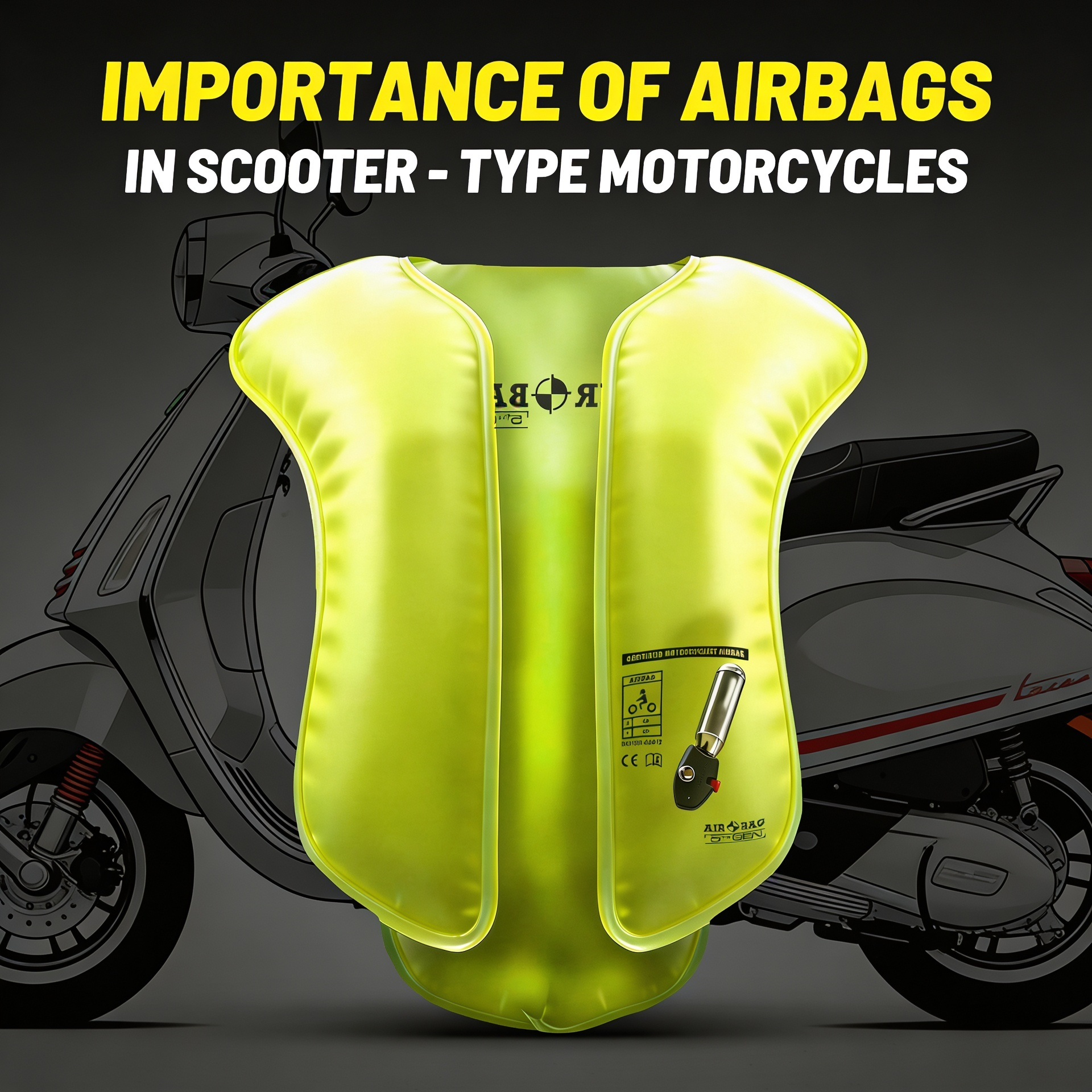
In the collective imagination, motorcycle safety is often associated with high speeds, open roads, and extreme scenarios. Under this logic, many scooter or urban motorcycle users assume that their risk level is lower and, therefore, protective gear can be more basic. However, when accident statistics are analyzed from a scientific and epidemiological perspective, this perception begins to crumble.
By definition, the city is not a safe environment. It is, in fact, a complex system where multiple variables converge: dense traffic, intersections, pedestrians, vehicles changing lanes unpredictably, and low-grip surfaces. All of this generates a characteristic type of accident: impacts at moderate speeds, but with high frequency and trajectories that are difficult to anticipate.
In this context, a question arises that is becoming increasingly relevant: does it make sense to use an airbag for urban commutes, or is it a disproportionate measure? To answer this, it is necessary to abandon intuition and analyze the data, impact biomechanics, and the actual functioning of protective systems.
The conceptual error: associating severity with speed
One of the biggest errors in road safety is thinking that the severity of an accident depends exclusively on speed. While kinetic energy increases with speed, mortality is not explained solely by this factor, but by the force that is ultimately transmitted to vital organs.
Accelerations are measured in g-forces or gravities where g= 9.8 m/s². Tolerance to g-forces depends on the magnitude and duration of the acceleration or deceleration and the orientation of the body. For example, fighter pilots withstand forces of 9 g before experiencing what is called g-LOC, or gravity-induced loss of consciousness. United States Air Force Captain Eli Lackland Beeding Jr. has held the world record since 1958 for withstanding 82.6 g for 40 milliseconds. However, after the experiment, he had to spend three days in a hospital.
To provide a reference for what speed a deceleration could become fatal, let's calculate how many gravities or g-forces vital human organs are exposed to at a speed of 18 km/hour or 5 mt/sec, where Final Velocity equals Initial Velocity plus acceleration times time.

If we clear for acceleration, we have:
If the average deceleration time of a motorcyclist's primary impact against a fixed object is 5 milliseconds, we have:

From the above equation, we can deduce that a human who crashes against a solid object at a speed of 18 km/hour experiences an instantaneous deceleration greater than 102 G-forces. In other words, 18 km/hour is already a fatal speed.
The city as a high-risk environment
Accident studies have consistently shown that most motorcycle accidents occur in urban environments. This is not by chance. The density of interaction between road users multiplies the probability of conflict.
In the city, scenarios such as:
- Collisions at intersections
- Rear-end collisions by other vehicles
- Unexpected opening of doors (dooring)
- Falls due to loss of traction
- Side impacts at low or medium speed
Although these events do not always involve high speeds, they do generate direct impacts on the motorcyclist's body, often without any structure to absorb the energy.
Unlike a car, the motorcyclist is completely exposed. There is no bodywork, no programmed deformation zones. The body is, literally, the first point of contact.
What happens to the body in an urban accident?
When a motorcyclist suffers a fall or collision in the city, the injury pattern follows a fairly clear biomechanical logic. The body experiences a combination of translation and rotation, which causes multiple impacts at different phases of the accident.
In these scenarios, the most compromised areas are:
- The torso and head due to direct impact against the vehicle or the ground
- The neck, due to sudden head movements
These areas concentrate the majority of serious injuries associated with mortality. These are not hypotheses, but conclusions derived from studies reconstructing real accidents.
The role of the airbag in urban environments
Motorcycle airbags are not designed exclusively for high-speed scenarios. Their function is to intervene at the critical moment of impact, regardless of the initial speed.
Its operation is based on a simple but powerful principle: increasing the deceleration time and distributing the impact energy.
In an urban accident, where impacts are fast and localized, this capability is especially relevant. The airbag creates a deformable barrier between the body and the impact object, reducing the maximum force transmitted.
In addition, it protects areas that other protective elements do not effectively cover, such as the neck and abdomen.
Reaction time: milliseconds that matter
One of the most frequent objections is whether the airbag can deploy in time in an urban accident, where everything happens very quickly.
Certified mechanical systems activate in milliseconds and reach full inflation in less than a tenth of a second. This interval is sufficient for the system to be operational before the main impact in most urban scenarios.
This is crucial because damage does not occur during movement, but at the instant the body abruptly stops. If the airbag is deployed at that moment, it can significantly alter the outcome of the accident.
Scooter does not mean lower risk
There is a widespread perception that scooters are safer due to their lower speed and ease of handling. However, as we saw at 18 km/hour, speed is already fatal, so this idea does not stand up to rigorous analysis.
Scooter users are often more exposed to:
- Short and repetitive commutes (greater accumulated exposure)
- Less use of protective equipment
- Dense urban environments
- Less experienced drivers
Furthermore, many scooters lack advanced active safety systems such as ABS brakes or traction control systems, which are present in higher-end motorcycles, increasing the probability of an accident.
From an epidemiological point of view, this translates into a high incidence of accidents in this segment, especially in cities.
Exaggeration or underestimation of risk?
The perception that the airbag is excessive in the city is usually based on an intuitive assessment of risk, not on objective data.
If the situation is analyzed from physics and biomechanics, the conclusion is different:
- Impact forces can be high even at low speeds
- The most vulnerable regions are not protected by other equipment
- Most accidents occur in urban environments
Under these conditions, the airbag is not an exaggeration, but a logical response to a well-identified problem.
The difference between falling and surviving
In many urban accidents, the difference between a fall without serious consequences and a critical injury does not depend on the accident itself, but on how the impact energy is distributed.
Without adequate protection, the body absorbs energy directly. With an airbag, that energy is dissipated into a structure designed to deform.
This change may seem subtle, but it has profound implications. It reduces the probability of thoracic injuries, limits dangerous neck movements, and protects organs that would otherwise be exposed.
A paradigm shift in urban safety
The incorporation of airbags in urban use represents a shift in how safety is understood. It is no longer just about preventing accidents, but about managing their consequences.
This approach is consistent with the evolution of safety in other areas, such as automotive, where passive systems have proven to be decisive in reducing mortality.
On a motorcycle, where exposure is total, this type of solution becomes even more relevant.
Conclusion
The idea that an airbag is unnecessary in the city stems from an oversimplification of the problem. The reality is that urban accidents occur at speeds above 18 km/hour, which, as we saw, is the speed at which a motorcyclist would suffer serious or fatal injuries to vital organs in the absence of certified protective elements.
The airbag does not eliminate risk, but it acts precisely at the point where damage occurs: the moment of impact. Its ability to deploy in milliseconds and modify the dynamics of the crash makes it a highly effective tool, even and especially in urban environments.
More than an exaggeration, its use in scooters and cities responds to a more precise understanding of risk. It's not about overreacting, but about aligning with scientific evidence.
Ultimately, the question is not whether it is necessary in all cases, but whether we are correctly assessing the risk to which we are exposed every time we ride in the city.
Share:
Is a motorcycle airbag mandatory? Regulations and future (2026)
Mechanical vs. Electronic Airbags: What's the Difference and Which Is Right for You?